in the tell-tale heart what does the narrator compare to the sound of the beating heart
| The Tell-Tale Heart | |
|---|---|
| by Edgar Allan Poe | |
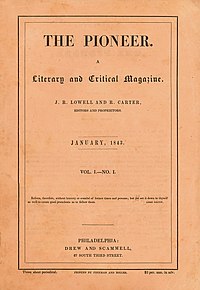 The Pioneer, Vol. I, No. I, Drew and Scammell, Philadelphia, Jan, 1843 | |
| Country | United states |
| Language | English language |
| Genre(due south) | Horror, Gothic Literature |
| Published in | The Pioneer |
| Publication type | Periodical |
| Publisher | James Russell Lowell |
| Media type | Print (journal) |
| Publication date | Jan 1843 |
| Text | The Tell-Tale Center at Wikisource |
"The Tell-Tale Heart" is a curt story by American writer Edgar Allan Poe, beginning published in 1843. It is related past an unnamed narrator who endeavors to convince the reader of the narrator's sanity while simultaneously describing a murder the narrator committed. The victim was an sometime man with a filmy stake blue "vulture-eye", as the narrator calls information technology. The narrator emphasizes the careful adding of the murder, attempting the perfect crime, complete with dismembering the body in the bathtub and hiding it under the floorboards. Ultimately, the narrator'due south actions result in hearing a thumping sound, which the narrator interprets as the expressionless human being's beating eye.
The story was commencement published in James Russell Lowell's The Pioneer in January 1843. "The Tell-Tale Heart" is oft considered a classic of the Gothic fiction genre and is one of Poe'due south best known short stories.
The specific motivation for murder (bated from the narrator'southward hatred of the old human'due south eye), the human relationship between narrator and erstwhile human being, the gender of the narrator, and other details are left unclear. The narrator denies having whatever feelings of hatred or resentment for the human who had, as stated, "never wronged" the narrator. The narrator also denies having killed for greed.
Critics argue that the old man could exist a father figure, the narrator'due south landlord, or that the narrator works for the erstwhile man as a servant, and that perhaps his "vulture-heart" represents a veiled undercover or ability. The ambivalence and lack of details nearly the two main characters stand in contrast to the specific plot details leading up to the murder.
Plot summary [edit]
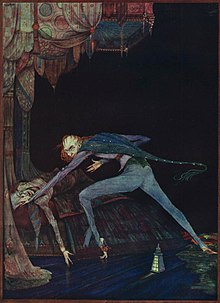
"The Tell-Tale Centre" is a first-person narrative told by an unnamed narrator. Despite insisting that they are sane, the narrator suffers from a disease (nervousness) which causes "over-affectibility of the senses".
The old man, with whom the narrator lives, has a overcast, pale, blue "vulture-like" heart, which distresses and manipulates the narrator then much that the narrator plots to murder the old man, despite also insisting that the narrator loves the old human being and has never felt wronged by him. The narrator is insistent that this conscientious precision in committing the murder proves that they cannot possibly be insane. For seven nights, the narrator opens the door of the old human being's room to smoothen a sliver of light onto the "evil center." However, the former man'due south vulture-center is always closed, making it incommunicable to "do the work," thus making the narrator go further into distress.
On the 8th dark, the old man awakens subsequently the narrator's manus slips and makes a racket, interrupting the narrator's nightly ritual. The narrator does non draw back and after some time, decides to open the lantern. A single thin ray of light shines out and lands precisely on the "evil heart," revealing that information technology is wide open. The narrator hears the quondam man'south eye chirapsia, which simply gets louder and louder. This increases the narrator'due south anxiety to the point where the narrator decides to strike. He jumps into the room and the old man shrieks one time before he is killed. The narrator then dismembers the trunk and conceals the pieces under the floorboards, ensuring the concealment of all signs of the law-breaking. Even so, the sometime man's scream during the night causes a neighbour to report to the police, who the narrator invites in to wait around. The narrator claims that the scream heard was the narrator's own in a nightmare and that the old human being is absent in the country. Confident that they volition not find whatsoever show of the murder, the narrator brings chairs for them and they sit in the old human being's room. The chairs are placed on the very spot where the trunk is concealed; the police suspect nothing, and the narrator has a pleasant and easy style.
The narrator begins to feel uncomfortable and notices a ringing in the narrator's ears. As the ringing grows louder, the narrator concludes that it is the heartbeat of the old man coming from nether the floorboards. The sound increases steadily to the narrator, though the officers do non seem to hear information technology. Terrified past the violent beating of the middle and convinced that the officers are aware of not simply the heartbeat only also the narrator's guilt, the narrator breaks downwardly and confesses. The narrator tells them to tear up the floorboards to reveal the remains of the former man's body.
Publication history [edit]
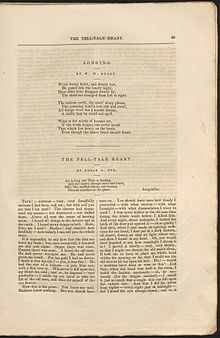
"The Tell-Tale Heart" in The Pioneer: A Literary and Critical Magazine, page 29
"The Tell-Tale Heart" was first published in January 1843 in the countdown upshot of The Pioneer: A Literary and Critical Mag, a short-lived Boston magazine edited by James Russell Lowell and Robert Carter who were listed as the "proprietors" on the front cover. The magazine was published in Boston by Leland and Whiting and in Philadelphia past Drew and Scammell.
Poe was likely paid $10 for the story.[i] Its original publication included an epigraph that quoted Henry Wadsworth Longfellow's verse form "A Psalm of Life."[two] The story was slightly revised when republished on August 23, 1845, edition of the Broadway Journal. That edition omitted Longfellow's poem because Poe believed it was plagiarized.[2] "The Tell-Tale Centre" was reprinted several more times during Poe's lifetime.[iii]
Assay [edit]
"The Tell-Tale Eye" uses an unreliable narrator. The exactness with which the narrator recounts murdering the old human being, as if the stealthy style in which they executed the law-breaking were bear witness of their sanity, reveals their monomania and paranoia. The focus of the story is the perverse scheme to commit the perfect law-breaking.[4] One author, Paige Bynum, asserts that Poe wrote the narrator in a way that "allows the reader to identify with the narrator".[5]
The narrator of "The Tell-Tale Heart" is by and large causeless to be a male person. However, some critics have suggested a woman may be narrating; no pronouns are used to clarify ane style or the other.[6] The story starts in medias res, opening with a chat already in progress between the narrator and another person who is not identified in any way. It has been speculated that the narrator is confessing to a prison warden, a judge, a reporter, a doctor, or (anachronistically) a psychiatrist.[seven] In any case, the narrator tells the story in slap-up detail.[8] What follows is a study of terror but, more specifically, the retention of terror as the narrator is retelling events from the past.[9] The first word of the story, "True!", is an admission of their guilt, as well as an assurance of reliability.[7] This introduction besides serves to gain the reader'due south attention.[10] Every word contributes to the purpose of moving the story frontwards, exemplifying Poe's theories about the writing of short stories.[11]
The story is driven non by the narrator's insistence upon their "innocence," merely by their insistence on their sanity. This, even so, is self-destructive, because in attempting to prove their sanity, they fully admit that they are guilty of murder.[12] Their denial of insanity is based on their systematic actions and their precision, as they provide a rational explanation for irrational behavior.[8] This rationality, however, is undermined by their lack of motive ("Object in that location was none. Passion in that location was none."). Despite this, they say, the idea of murder "haunted me day and night."[12] It is difficult to fully empathise the narrator's true emotions about the blueish-eyed man because of this contradiction. It is said that "At the aforementioned fourth dimension he disclosed a deep psychological defoliation", referring to the narrator and the comment that "Object there was none. Passion there was none" and that the idea of murder "haunted me day and night."[13]
The story'due south final scene shows the result of the narrator'due south feelings of guilt. Like many characters in Gothic fiction, they allow their fretfulness to dictate their nature. Despite their best efforts at defending their actions, their "over-acuteness of the senses"; which helps them hear the heart beating beneath the floorboards, is testify that they are truly mad.[xiv] The guilt in the narrator can exist seen when the narrator confessed to the police force that the body of the one-time man was under the floorboards. Even though the erstwhile man was dead, the body and middle of the expressionless man still seemed to haunt the narrator and convict them of the act. "Since such processes of reasoning tend to convict the speaker of madness, information technology does not seem out of keeping that he is driven to confession", co-ordinate to scholar Arthur Robinson.[13] Poe'south contemporaries may well have been reminded of the controversy over the insanity defense in the 1840s.[15] The confession tin can exist due to a concept called "Illusion of transparency". According to the "Encyclopedia of Social Psychology", "Poe's character falsely believes that some police officers can sense his guilt and anxiety over a criminal offence he has committed, a fear that ultimately gets the all-time of him and causes him to requite himself upwardly unnecessarily".[sixteen]
The narrator claims to have a illness that causes hypersensitivity. A similar motif is used for Roderick Usher in "The Fall of the Firm of Usher" (1839) and in "The Colloquy of Monos and Una" (1841).[17] It is unclear, however, if the narrator really has very acute senses, or if it is merely imagined. If this status is believed to be true, what is heard at the end of the story may non exist the one-time man's heart, but deathwatch beetles. The narrator commencement admits to hearing deathwatch beetles in the wall after startling the onetime man from his slumber. According to superstition, deathwatch beetles are a sign of impending death. I variety of deathwatch beetle raps its head against surfaces, presumably as function of a mating ritual, while others emit ticking sounds.[17] Henry David Thoreau observed in an 1838 article that deathwatch beetles brand sounds like to a heartbeat.[18] The discrepancy with this theory is that the deathwatch beetles make a "uniformly faint" ticking sound that would have kept at a consistent footstep but as the narrator drew closer to the old man the audio got more rapid and louder which would not have been a issue of the beetles.[19] The beating could fifty-fifty exist the sound of the narrator's own heart. Alternatively, if the beating is a product of the narrator's imagination, it is that uncontrolled imagination that leads to their ain destruction.[twenty]
Information technology is also possible that the narrator has paranoid schizophrenia. Paranoid schizophrenics very oftentimes feel auditory hallucinations. These auditory hallucinations are more oft voices, merely tin also be sounds.[21] The hallucinations practise not need to derive from a specific source other than one's head, which is another indication that the narrator is suffering from such a psychological disorder.[19]
The relationship betwixt the old man and the narrator is ambiguous. Their names, occupations, and places of residence are not given, contrasting with the strict attention to detail in the plot.[22] The narrator may be a servant of the old man'southward or, as is more often causeless, his kid. In that case, the "vulture-center" of the old human being as a begetter figure may symbolize parental surveillance or the paternal principles of right and wrong. The murder of the eye, then, is removal of conscience.[23] The eye may as well stand for secrecy: just when the centre is found open up on the final night, penetrating the veil of secrecy, is the murder carried out.[24]
Richard Wilbur suggested that the tale is an emblematic representation of Poe's verse form "To Science", which depicts a struggle between imagination and science. In "The Tell-Tale Heart", the old man may thus correspond the scientific and rational mind, while the narrator may stand for the imaginative.[25]
Adaptations [edit]
- The earliest acknowledged accommodation of "The Tell-Tale Heart" was in a 1928 20-minute American silent film of that title[26] co-directed by Leon Shamroy and Charles Klein, and starring Otto Matieson equally "The Insane", William Herford every bit "The One-time Man" with Charles Darvas and Hans Fuerberg as "Detectives". It was faithful to the original tale,[6] unlike time to come television and film adaptations which frequently expanded the short story to full-length feature films.[27] [ unreliable source? ]
- The primeval known "talkie" adaptation was a 1934 version filmed at the Blattner Studios, Elstree, by Clifton-Hurst Productions, directed by Brian Desmond Hurst and starring Norman Dryden. This version was 55 minutes in length.
- A 1941 live-action accommodation starred Joseph Schildkraut and was the directorial debut of Jules Dassin This version differs profoundly from the original tale, depicting the murderer as driven mad later on suffering years of abuse by the mean older human.
- A 1953 animated short film produced by United Productions of America and narrated by James Stonemason is included among the list of films preserved in the United States National Movie Registry.
- Likewise in 1953, an EC Comics adaptation of "The Tell-Tale Eye" entitled "Sleep No More than", written by William Gaines and Al Feldstein and illustrated by George Evans (cartoonist) appeared in Stupor SuspenStories.[28]
- In 1956, an adaptation of "The Tell-Tale Heart" was written by William Templeton for the NBC Matinee Theater and aired on 6 Nov 1956.
- A 1960 movie adaptation, The Tell-Tale Heart, adds a dear triangle to the story.
- An Australian ballet was based on the story, and was recorded for boob tube in the early on 1960s.[29]
- In 1970, Vincent Price included a solo recitation of the story in the anthology movie An Evening of Edgar Allan Poe.
- A 1971 moving picture adaptation directed by Steve Carver, and starring Sam Jaffe as the former man.
- CBS Radio Mystery Theater performed an adaptation of the story in 1975; the bandage included Fred Gwynne.
- The Canadian radio programme Nightfall presented an adaptation on August 1, 1980.
- A musical adaptation performed by The Alan Parsons Project was released on their 1976 debut anthology Tales of Mystery and Imagination, and was subsequently covered by Slough Feg for their 2010 anthology, The Animal Spirits.
- Steven Berkoff adapted the story in 1991, and was broadcast on British television set. This adaptation was originally presented on British Television as office of the acclaimed series "Without Walls".
- The song "Ol' Evil Eye" off of the 1995 album Riddle Box by the Insane Clown Posse adapts a version of the story, besides as sampling audio from a reading of the original story.
- The Radio Tales series produced The Tell-Tale Heart for National Public Radio in 1998. The story was performed by Winifred Phillips along with music equanimous past her.
- The 1999 episode of SpongeBob SquarePants entitled "Squeaky Boots" loosely adapts the short story.
- The picture Nightmares from the Heed of Poe (2006) adapts "The Tell-Tale Heart" along with "The Cask of Amontillado", "The Premature Burial" and "The Raven".
- The 2009 thriller pic Tell-Tale, produced by Ridley Scott and Tony Scott, credits Poe's "The Tell-Tale Eye" as the basis for the story of a man being haunted by his donor's memories, after a heart transplant.[30] [ unreliable source? ]
- V. H. Belvadi's 2012 short moving picture, Telltale, credits Poe'southward "The Tell-tale Heart" as its inspiration and uses some dialog from the original work.
- Poe's Tell-Tale Eye: The Game, is a 2013 mobile game adaptation in which players enact the protagonist'southward actions to recreate Poe's story on Google Play[31] and Apple iOS.
- The 2015 blithe anthology Extraordinary Tales includes "The Tell-Tale Centre", narrated by Bela Lugosi.
- The 2015 Lifetime film The Murder Pact, starring Alexa Vega, is based on Poe'due south piece of work and incorporates allusions to information technology, such every bit the "vulture eye" from "The Tell-Tale Eye".[32]
- In April 2016, a pic adaption directed by John Le Tier was released, entitled The Tell-Tale Eye. It starred Peter Bogdanovich, Rose McGowan, and Patrick Flueger in the pb role. Information technology featured a total narration of Poe'southward story with added elements imagining the narrator as a former tortured soldier with PTSD.
- Redrum (2018), an Indian Hindi-linguistic communication film, adapts the story.[33]
- In December 2018, Anthony Neilson'south stage adaptation was presented at London's National Theatre.[34]
References [edit]
- ^ Silverman, Kenneth. Edgar A. Poe: Mournful and Never-catastrophe Remembrance. New York: Harper Perennial, 1991. ISBN 0-06-092331-8, p. 201.
- ^ a b Moss, Sidney P. Poe'southward Literary Battles: The Critic in the Context of His Literary Milieu. Southern Illinois University Press, 1969. p. 151
- ^ ""The Tales of Edgar Allan Poe" (index)". eapoe.org. The Edgar Allan Poe Society of Baltimore. September xxx, 2007. Retrieved 2007-xi-05 .
- ^ Kennedy, J. Gerald. Poe, Expiry, and the Life of Writing. Yale University Press, 1987. p. 132; ISBN 0-300-03773-2
- ^ Bynum P.M. (1989) "Observe How Healthily – How Calmly I Can Tell Y'all the Whole Story": Moral Insanity and Edgar Allan Poe'southward 'The Tell-Tale Centre'. In: Amrine F. (eds) Literature and Science as Modes of Expression. Boston Studies in the Philosophy of Science, vol 115. Springer, Dordrecht. https://doi.org/10.1007/978-94-009-2297-6_8
- ^ a b Sova, Dawn B. Edgar Allan Poe: A to Z. New York City: Checkmark Books, 2001: 234. ISBN 0-8160-4161-X
- ^ a b Benfey, Christopher. "Poe and the Unreadable: 'The Black True cat' and 'The Tell-Tale Eye'", in New Essays on Poe's Major Tales, Kenneth Silverman, ed. Cambridge University Press, 1993. ISBN 978-0-521-42243-seven, p. xxx.
- ^ a b Cleman, John. "Irresistible Impulses: Edgar Allan Poe and the Insanity Defense", in Flower's BioCritiques: Edgar Allan Poe, edited by Harold Bloom. Philadelphia: Chelsea House Publishers, 2002. ISBN 0-7910-6173-six, p. lxx.
- ^ Quinn, Arthur Hobson. Edgar Allan Poe: A Critical Biography. Baltimore: The Johns Hopkins University Press, 1998. ISBN 0-8018-5730-9. p. 394
- ^ Meyers, Jeffrey. Edgar Allan Poe: His Life and Legacy. Cooper Square Press, 1992. p. 101. ISBN 0-8154-1038-vii
- ^ Quinn, Arthur Hobson. Edgar Allan Poe: A Critical Biography. Baltimore: The Johns Hopkins University Printing, 1998. p. 394. ISBN 0-8018-5730-9
- ^ a b Robinson, E. Arthur. "Poe's 'The Tell-Tale Heart'" in Twentieth Century Interpretations of Poe'due south Tales, edited by William L. Howarth. Englewood Cliffs, NJ: Prentice-Hall Inc., 1971, p. 94.
- ^ a b Robinson, E. Arthur (1965). "Poe's "The Tell-Tale Heart"". Academy of California Press. nineteen (4): 369–378. JSTOR 2932876.
- ^ Fisher, Benjamin Franklin. "Poe and the Gothic Tradition", in The Cambridge Companion to Edgar Allan Poe, edited by Kevin J. Hayes. Cambridge University Printing, 2002. ISBN 0-521-79727-6, p. 87.
- ^ Cleman, Flower's BioCritiques, p. 66.
- ^ Baumeister, Roy F.; Vohs, Kathleen D. (2007). Encyclopedia of Social Psychology. Thousand Oaks, Calif: Sage Publications, Inc. p. 458. ISBN9781412916707. ISBN 9781452265681
- ^ a b Reilly, John E. "The Bottom Expiry-Sentry and "'The Tell-Tale Heart' Archived Dec 18, 2009, at the Wayback Machine", in The American Transcendental Quarterly. 2nd Quarter, 1969.
- ^ Robison, East. Arthur. "Thoreau and the Deathwatch in Poe'south 'The Tell-Tale Heart'", in Poe Studies, vol. Four, no. 1. June 1971. pp. 14–xvi
- ^ a b Zimmerman, Brett (1992). ""Moral Insanity" or Paranoid Schizophrenia: Poe's "The Tell-Tale Eye"". Mosaic: A Journal for the Interdisciplinary Study of Literature. 25 (2): 39–48. JSTOR 24780617.
- ^ Eddings, Dennis W. "Theme and Parody in 'The Raven'", in Poe and His Times: The Artist and His Milieu, edited by Benjamin Franklin Fisher Iv. Baltimore: The Edgar Allan Poe Lodge, 1990. ISBN 0-9616449-2-3, p. 213.
- ^ Zimmerman, Brett. "'Moral Insanity' or Paranoid Schizophrenia: Poe'due south 'The Tell-Tale Heart.'" Mosaic: A Journal for the Interdisciplinary Study of Literature, vol. 25, no. two, 1992, pp. 39–48. JSTOR 24780617.
- ^ Benfey, New Essays, p. 32.
- ^ Hoffman, Daniel. Poe Poe Poe Poe Poe Poe Poe. Baton Rouge: Louisiana State University Press, 1972. ISBN 0-8071-2321-8, p. 223.
- ^ Benfey, New Essays, p. 33.
- ^ Benfey, New Essays, pp. 31–32.
- ^ Workman, Christopher; Howarth, Troy (2016). Tome of Terror: Horror Films of the Silent Era. Midnight Marquee Press. p. 332. ISBN978-1936168-68-2.
- ^ "IMDb Championship Search: The Tell-Tale Heart". Internet Movie Database. Retrieved 2007-09-01 .
- ^ "Sleep No More", by Bill Gaines and Ed Feldstein, Shock SuspenStories, April 1953.
- ^ "Archived copy". Archived from the original on 2016-05-18. Retrieved 2015-05-01 .
{{cite spider web}}: CS1 maint: archived copy as championship (link) - ^ Malvern, Jack (23 October 2018). "Edgar Allen Poe's horror classic The Tell‑Tale Centre dorsum from the dead afterward attic clear‑out". The Times . Retrieved 30 Nov 2018.
- ^ "Poe'southward Tell-Tale Centre:The Game - Android Apps on Google Play". Play.google.com . Retrieved 2016-01-xvi .
- ^ Traciy Reyes. "'The Murder Pact': Lifetime Film, Also Known As 'Tell-Tale Lies', Arrogance Tonight Featuring Music Past Lindsey Stirling". Inquisitr.com . Retrieved 2016-01-16 .
- ^ Ribeiro, Troy (nine Baronial 2018). "'Redrum: A Love Story': A rehash of skewed love stories (IANS Review, Rating: *one/two)". Business Standard . Retrieved 13 April 2020.
- ^ Malvern, Jack (23 October 2018). "Edgar Allen Poe's horror classic The Tell‑Tale Centre back from the dead after attic clear‑out". The Times.
External links [edit]
- "The Poe Museum"– Total text of "The Tell-Tale Heart"
- "The Tell-Tale Heart"– Full text of the showtime printing, from the Pioneer, 1843
- Mid-20th century radio adaptations of "The Tell-Tale Heart"
- "The Tell-Tale Heart" written report guide and didactics guide– themes, assay, quotes, teacher resources
- "The Tell-Tale Heart" animation– Award-winning 2010 animated movie, teacher resources, student games
- 20 LibriVox audiorecordings, read by various readers
- The Pioneer, Jan, 1843, Boston edition.
Source: https://en.wikipedia.org/wiki/The_Tell-Tale_Heart
0 Response to "in the tell-tale heart what does the narrator compare to the sound of the beating heart"
Post a Comment